Slave Configuration: 'CoE Data' editor - CoE Object Dictionary
The 'CoE Data' editor is available for each EtherCAT slave device in your PLANT. It implements and provides access to the Object Dictionary according to the CAN-over-EtherCAT (CoE) protocol which is defined for the particular slave.
For CoE, editable and fixed parameters of a device are included in a so-called Object Dictionary. An object can contain one or more parameters. Each parameter has several properties:- Index: unique parameter identification. If several parameters belong together, their indices are composed of the same main index and a subindex separated by a colon (MainIndex:SubIndex).
- Name: descriptive and comprehensive parameter name.
- Value: value of the parameter. The value type and range depends on the data type (see next item).
- Type: data type of the parameter (Boolean, integer number, text, or possibly another index).
- Flags: specification whether the parameter value can only be read or also written (edited).
 Description of the flags
| Further Info
Information about the structure of the Object Dictionary and the contained objects can be found in the manual of your slave station. |
Content/structure of the Object Dictionary
The Object Dictionary can be edited if this is enabled by the slave devices. If enabled, the slave may allow to add own customer-specific objects. Editing and adding is currently not supported in iCube Engineer and the 'CoE Data' editor is read-only.
| Note
The possibility of adding parameters will be implemented in future. |
Index groups
According to the EtherCAT standard, the objects are grouped into different index ranges. Further or deviating index ranges are possible depending on the slave device/manufacturer.- 0x1000 and following: identity-related parameters such as device type, name, firmware, and hardware version etc.
- 0x6000 and following: receive process data (input data for the EtherCAT Master).
Into this index data area, the input PDOs selected for the slave are embedded. - 0x7000 and following: transmit process data (output data of the EtherCAT Master).
Into this index data area, the output PDOs selected for the slave are embedded. - 0x4000 or 0x8000 and following: functional parameters relevant for device configuration or operation.
In iCube Engineer these indices are not visible for Yaskawa devices. The reason is that the parameterization of Yaskawa device is done via the 'Settings' editor of each device but not via CoE objects. - 0x1F00: diagnostic objects
Modifying an object value
If a value is editable (indicated by its flags), you can modify it as follows:- Select the object to be edited.
- Enter the desired value (in decimal or hexadecimal format) into the field below the grid and select the input format with the buttons provided.
- Click 'Apply'.
The new value is entered into the grid row. A new init command is created and appended to the 'Init commands' list.
An example is shown in section "Slave Configuration: 'Init commands'".
Objects can be mapped to PDOs
The CoE protocol allows the user to map objects to process data objects (PDOs) in order to use the PDOs for realtime data transfer. The PDO mappings define which objects will be included in the PDOs.
| Note
The user-defined mapping of objects to PDOs is not yet supported. The 'PDO Data' editor currently shows the PDOs defined in the EtherCAT slave information (ESI) file and what is available in the 'Data List' for assignment. |
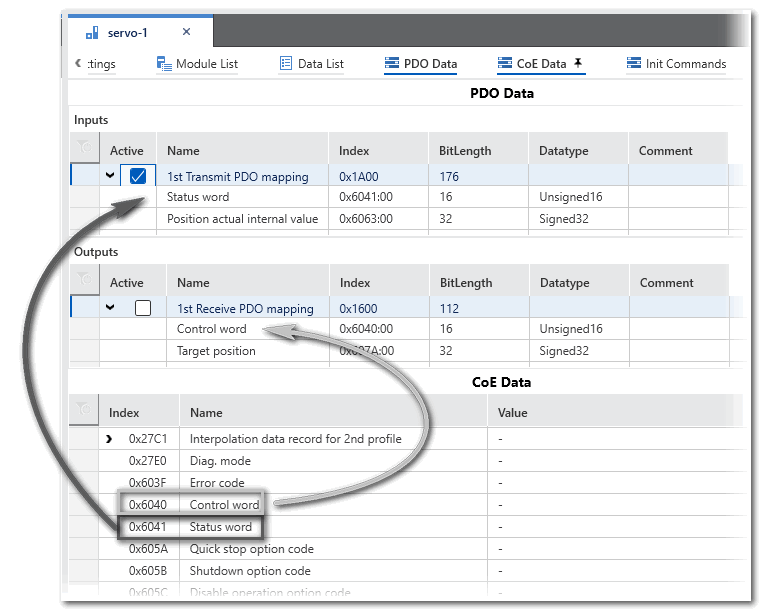
Example: The object 'Status word' is mapped in the PDO '1st Transmit PDO mapping' of servo-1 which is received by the master from the slave. The object 'Control word' is mapped in the PDO '1st Receive PDO mapping' of servo-1 which is sent from the master to the slave.