|
Type
| Function blockTOF is available as standard (non-safety-related) and safety-related type (TOF_S). For the safety-related type, the safety-related data types (SAFE*) are expected at the formal parameters. There is no safety-related type for LTIME. |
|
Description
| Provides a timer for delayed switching off. When the IN input switches from TRUE to FALSE, the Q output is reset to FALSE after the delay time has elapsed. If the IN input is TRUE, the output Q will be TRUE.If IN changes from TRUE to FALSE, switching off is delayed for the duration of the time interval applied to the input PT. After PT has elapsed, Q is set to FALSE. The elapsed time interval is indicated at the output ET. |
|
Notes
|
|
|
Parameters
| Inputs
 IN IN
| Data type: | (SAFE)BOOL |
| Description: | If a falling edge is detected, the off-delay timing is started. |
PT
| Data type: | TOF / TOF_S: (SAFE)TIMETOF_LTIME: LTIME |
| Description: | Preset time interval for the delay. The time value must be positive. |
Outputs
Q
| Data type: | (SAFE)BOOL |
| Description: | TRUE if IN = TRUE and ET < PT.
FALSE if IN = FALSE and ET >= PT. |
ET
| Data type: | TO / TOF_S: (SAFE)TIMETOF_LTIME: LTIME |
| Description: | Elapsed time interval. |
|
|
Timing Diagram
| Timing diagram
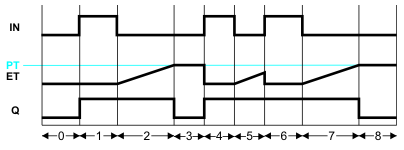
| 0 | The IN input is FALSE. As a result, Q is also set to FALSE. |
| 1 | IN switches from FALSE to TRUE. Q is set to TRUE immediately. |
| 2 | IN switches from TRUE to FALSE. The measurement of the elapsed time is started. |
| 3 | When the delay time PT has elapsed (ET = PT), Q is reset to FALSE. |
| 4 | IN switches from FALSE to TRUE. Q is set to TRUE immediately. |
| 5 | IN switches from TRUE to FALSE. The measurement of the elapsed time is started once more. |
| 6 | IN switches back to TRUE before the PT has elapsed. As a result, Q remains TRUE. |
| 7 | IN switches from TRUE to FALSE again. The measurement of the elapsed time is started once more. |
| 8 | When the delay time PT has elapsed (ET = PT), Q is reset to FALSE. |
|